Large glass surfaces, open atriums and transparent escape routes shape contemporary design. But where the architect sees transparency, the building authority sees potential fire loads and hazard areas. In Germany, fire protection is not a mere recommendation but is strictly regulated by the state building codes (Landesbauordnungen, LBO) of the 16 federal states.
The complexity arises from German federalism: while the physical laws of fire are the same everywhere, the legal requirements for components such as fire-rated glazing often differ in detail between North Rhine-Westphalia, Bavaria or Berlin. For planners, architects and investors this means: anyone who does not know the subtleties of the LBO risks costly redesigns, delays in approval or, in the worst case, liability in the event of damage.
The Legal Basis: MBO vs. LBO
The Model Building Code (Musterbauordnung, MBO) serves as a framework for guidance, issued by the Conference of Building Ministers. It has no legal force of its own but is the template for the 16 state building codes.
Why the differentiation?
Each federal state has the right to adapt the MBO to regional needs. For example, the BauO NRW often contains stricter fire-protection requirements in densely populated urban areas, while the BayBO (Bavarian Building Code) has deviated from the MBO in recent years through simplifications in timber construction.
Important for planners: The decisive code is always the LBO of the federal state in which the building project is realised. In addition, the relevant special-building ordinances (e.g. for assembly venues, hospitals or retail premises) must be consulted, as they often tighten or specify the requirements of the LBO.
Building Classes (GK 1–5): The Backbone of Planning
- GK 1 & 2: Detached residential buildings or small units up to 7 m in height. Requirements for interior fire protection are moderate. Here, fire-rated glass is often relevant only for boundary developments or special boiler rooms.
- GK 3: Buildings up to 7 m in height but with more than two usage units. The LBO often requires „fire-retardant“ components (30 minutes). Transparent partitions in corridors must already meet fire-protection standards here – for example with ARDOREX® Arnold Fire in class EI 30, which as laminated glass achieves a light transmission of up to 86 % (Source: ARDOREX® data sheet, as of 11/2024).
- GK 4: Buildings up to 13 m in height and usage units up to 400 m². The requirement rises to „highly fire-retardant“ (60 minutes). This is a critical threshold, as the trade-off between E 60 (integrity) and EI 60 (insulation) often has to be made here. ARDOREX® Arnold Fire EI 60.18 offers a proven solution with a Ug value of 4.6 W/(m²K) in laminated glass.
- GK 5 & special buildings: Buildings over 13 m in height or buildings of special type and use. As a rule, „fire-resistant“ (90 minutes) applies here. In the stairwells of these classes, planning is barely possible without high-performance fire-rated glass (EI 90) if transparency is desired. ARDOREX® Arnold Fire EI 90.24 meets this requirement at a light transmission of up to 84 %.
Protection Objectives of the LBO: The Logic Behind the Regulations
- Preventing the outbreak of fire: Glass plays a subordinate role here, as it is classified as a non-combustible building material (A1/A2 according to DIN 4102).
- Limiting the spread of fire: This is where fire-rated glazing comes into its own. It must prevent a fire from jumping from one fire compartment to the next (fire walls, partition walls).
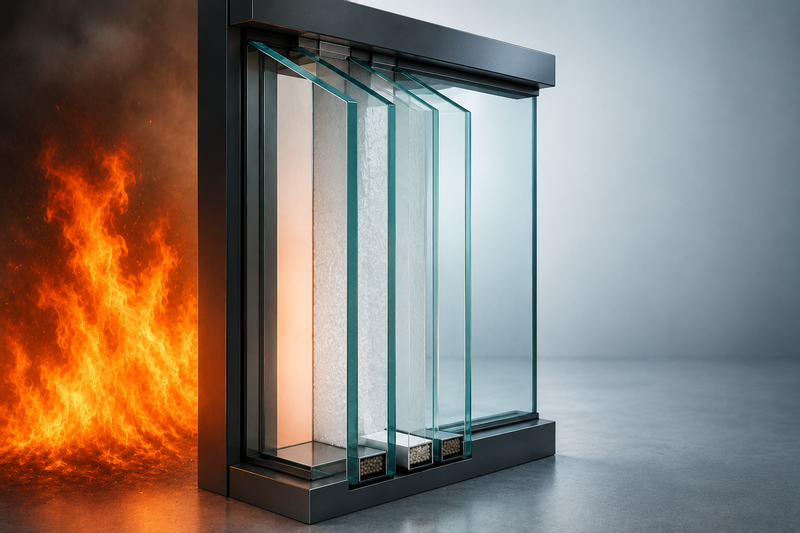
- Rescuing people and animals: This is the most critical objective. Escape routes (necessary corridors and stairwells) must remain free of smoke and protected from radiant heat for a defined period. This is precisely where ARDOREX® shows its strength: the hydrogel layer keeps the temperature on the cold side, on average, below a 140 K increase over the initial temperature.
Technical Classification: E, EW and EI in Detail
Planners must master the European classification according to DIN EN 13501-2 in order to implement the requirements of the LBO correctly.
E (Integrity) – Room Closure
Formerly referred to as G-glass. These glazings only prevent the passage of flames and smoke. However, dangerous thermal radiation passes through the glass almost unhindered. Use according to the LBO: only where there are no combustible materials nearby and no persons are directly endangered (e.g. skylights, partitions without escape-route relevance).
EW (Radiation) – Radiation Limitation
An intermediate step that is rarely explicitly required in the German LBOs but is often used as compensation. EW glass limits radiant heat to a value below 15 kW/m² at a distance of one metre.
EI (Insulation) – Thermal Insulation
Referred to nationally as F-glass. This is the highest standard in terms of fire protection. EI glass provides full protection against flames, smoke and heat. On the side facing away from the fire, the pane may heat up by an average of no more than 140 K above the initial temperature. ARDOREX® Arnold Fire meets this requirement in classes EI 30 to EI 120 (Source: ARDOREX® data sheet, as of 11/2024). Use according to the LBO: mandatory for all glazing in necessary corridors and stairwells to ensure safe evacuation.