


Why the Structure Matters More Than the Glass Thickness
Anyone dealing with fire-resistant glass for the first time often expects a simple logic: the thicker the glass, the higher the level of fire protection. In practice, however, this assumption falls short. The protective performance of fire-resistant glass is not primarily created by massive panes, but by the internal structure and the interaction of different materials.
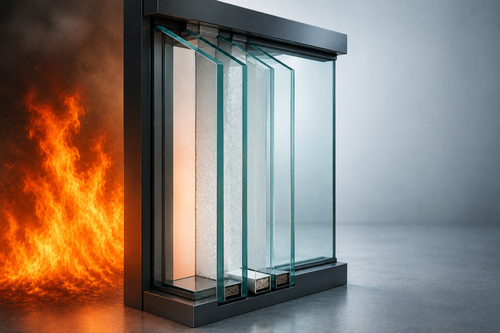
Fire-resistant glass is always a functional system. Its performance results from the way glass panes, interlayers and, depending on the application, additional insulating glass units are combined. Only these layer systems make it possible to control fire, smoke and heat for a defined period of time.
Basic Principle of Modern Fire-Resistant Glazing
Regardless of the specific manufacturer or system, fire-resistant glass usually follows a similar construction principle. Several glass panes are built up into a composite unit, with special fire protection layers between them. In their normal state, these layers are transparent and have little effect on the visual appearance.
In the event of a fire, however, they deliberately change their physical properties. This controlled reaction is what distinguishes fire-resistant glass from conventional safety glazing. While normal glass fails uncontrollably when exposed to heat, the behavior of fire-resistant glass is part of the tested system performance.
Silicate-Based, Intumescent Layer Systems
A widely used approach is based on silicate-based or alkali-silicate-based interlayers. These layers react intumescently when exposed to rising temperatures, meaning that they undergo a strong foaming process. Within a short time, the originally transparent layer turns into a dense, opaque structure.
This structure performs several functions at the same time. It has an insulating effect, absorbs energy and prevents flames or hot smoke gases from reaching the side facing away from the fire. At the same time, it limits heat transfer. In multilayer constructions, this process repeats layer by layer, maintaining the protective effect throughout the entire tested period.
Silicate-based, intumescent systems are mainly used where, in addition to compartmentation, a limitation of heat exposure is required. They are characteristic of many tested fire-resistant glazing systems.
Hydrogel-Based Layer Systems
Another technical approach uses transparent hydrogel layers in the cavity between the panes. These contain bound water, which evaporates in a controlled way in the event of a fire. The resulting evaporation energy dissipates heat and delays the temperature rise on the cold side.
In practice, a typical sequence can often be observed. The glass pane facing the fire is exposed to severe stress first and may fail relatively early. At this point, the hydrogel layer takes over the protective function and ensures that the pane on the side facing away from the fire remains stable. At the same time, heat transfer is significantly limited, or heat transmission is effectively reduced or prevented. Compartmentation is thus maintained throughout the entire classification period.
Hydrogel-based composite constructions are an example of how different material principles can lead to the same protection objective. A specific application of this principle can be found in ARDOREX, where hydrogel-based layer systems form the basis of the protective performance.
The specific design and the permitted system combinations always depend on the tested overall construction.
Glass Types in Composite Constructions
In most cases, classic float glass is used as the carrier material. Depending on the requirements, it is combined with other types of glass to achieve additional properties.
Laminated safety glass ensures that glass fragments remain bonded in the event of breakage and do not fall out of the composite. Toughened glass increases mechanical load-bearing capacity and resistance to temperature changes.
Borosilicate glass plays a special role. Due to its high softening point, it remains dimensionally stable and transparent even at very high temperatures. In applications where visual contact during a fire is important, this can be a decisive advantage. Borosilicate glass is therefore used specifically in certain fire-resistant systems, without replacing the basic composite structure.
Multi-Pane and Insulating Glass Constructions
Modern fire-resistant glazing is increasingly part of complex multi-pane constructions. Especially in facade applications or exterior building components, a monolithic fire-resistant pane is often not sufficient. Additional requirements for thermal insulation, comfort and energy efficiency also have to be met.
Fire-resistant insulating glass therefore combines a fire protection composite pane with additional functional glass panes. These can be designed as double or triple insulating glass units and enable low thermal transmittance values while maintaining high light transmission.
The fire protection core remains unchanged. What is decisive is that these combinations are also tested and approved as complete systems. The insulating glass construction complements the function, but does not replace it.
System Concept Instead of Individual Product
One point that is repeatedly underestimated in practice is the consistent system concept. Fire-resistant glass is not an interchangeable individual product, but always part of a tested complete system. The structure of the glazing, the type of layers and the materials used are firmly coordinated with specific frame, fixing and connection solutions.
An identical glass can therefore have completely different approvals in different systems. Conversely, even an apparently small difference in the layer structure can determine whether a glazing system is suitable for a particular application or not. This is precisely where it becomes clear that statements about the structure of fire-resistant glazing always also have a legal dimension.
Definition, meaning and legal classification of fire-resistant glass
Influence of the Structure on Planning and Design
The internal structure of fire-resistant glass has a direct impact on planning and design. Layer systems influence glass thickness, weight and visual appearance. They determine whether large formats are possible, how slim the frames may be and whether corner solutions can be realized.
In early planning phases, this relationship is often underestimated. Fire-resistant glass initially appears to be a later detail decision. In reality, however, the selected structure determines at an early stage which architectural options will later be available. Anyone who only considers the layer system during execution planning will often encounter unexpected limitations.
Sustainability and Material Development
Sustainability is also becoming increasingly important in the field of materials and layer systems. Glass itself is durable and generally recyclable. However, the composite layers used in fire-resistant glass still make recycling more difficult.
Manufacturers are therefore working on layer systems that allow better separation or require less material. At the same time, production processes are becoming more energy-efficient, and environmental declarations are increasingly becoming part of product communication. In the long term, the structure of fire-resistant glass can also be expected to continue developing toward more resource-efficient systems.
Conclusion
The structure of fire-resistant glass is the key to its protective performance. Only the interaction of glass panes, fire protection layers and, depending on the application, insulating glass units enables controlled behavior in the event of a fire. Different material systems follow different physical principles, but lead to the same goal: compartmentation, protection against smoke and limitation of heat exposure.
For planning and execution, this means that fire-resistant glass must always be understood as a system. Taking the internal structure into account at an early stage creates the basis for safe, functional and architecturally convincing solutions, regardless of which specific system is ultimately used.


