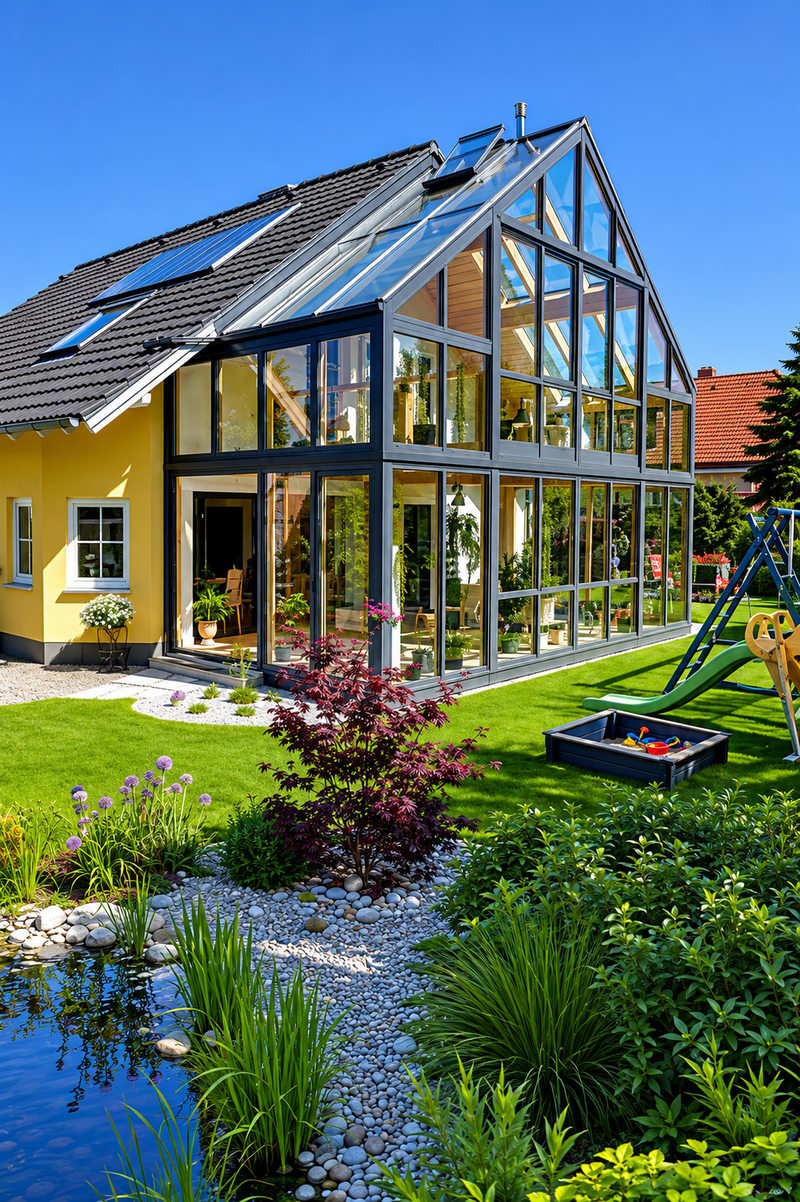
The Paradox of Light and Heat: The Selectivity Value as a Key Metric of Modern Glass Architecture
In contemporary architecture, the glass envelope is no longer merely a passive building component. It is a highly sophisticated filter system that must navigate the narrow line between maximum transparency and energy efficiency. While developers and architects often focus on U-value (thermal insulation) or g-value (solar control), a third parameter provides insight into the actual quality of a glazing system: the selectivity value.
This value measures the intelligence of a coating. It determines whether a building becomes a summer “heat trap” or whether it can remain flooded with natural daylight despite reduced solar heat gain.
1. The Physical Symbiosis: What Selectivity Really Measures
Selectivity (S) is not a direct physical unit but rather a ratio. It relates visible light transmission (Tv) to total solar energy transmittance (g-value).
European Definition According to DIN EN 410
Within European standards, these metrics are used to assess the efficiency of spectral filtering. The formula is:
S = Tv / g
Visible Light Transmission (Tv)
This indicates the percentage of visible solar radiation (380 to 780 nm) transmitted through the glass.
Total Solar Energy Transmittance (g-value)
This measures the total solar energy entering the building interior through the glazing system, consisting of:
- Direct solar radiation transmission
- Secondary heat radiation emitted inward from glass panes warmed by absorption
The Objective:
A high numerator (Tv) combined with a low denominator (g-value).
A glass allowing 70% visible light transmission while permitting only 35% solar heat gain achieves a selectivity of 2.0.
2. The Evolution of Coating Technology: From the “Darkroom Effect” to High-Performance Selectivity
For many years, the history of solar control glazing was defined by compromise.
Early solar control glass was typically either:
- Strongly tinted absorption glass
- Metallic reflective glass
Both approaches reduced g-value but also dramatically lowered visible light transmission. Occupants remained cooler but often needed artificial lighting even in broad daylight — an energetic and psychological disadvantage.
Magnetron Sputtering as a Gamechanger
Today’s high-performance selectivity is achieved through magnetron sputter coating technology.
In this high-vacuum process, extremely thin noble metal layers (typically silver) are applied to the glass surface.
Depending on the coating structure:
- Double-silver coatings achieve selectivity values of approximately 1.8 to 1.9
- Modern triple-silver technologies, used in selected high-performance products, can exceed values of 2.1
These coatings function as “spectral filters.” They are engineered to allow shortwave solar radiation (visible light) to pass while reflecting a substantial portion of longwave infrared radiation (heat energy).
This creates an optimal combination of:
- High daylight transmission
- Effective summer heat protection
3. Strategic Planning: Why High Selectivity Values Are Becoming Increasingly Important
In modern specialist planning, the selectivity value is an important performance indicator for solar control glass.
However, suitable values depend heavily on:
- Building usage
- Building type
- Façade design
- Climatic conditions
- Architectural goals
Particularly in demanding glazing applications, high selectivity values are becoming increasingly significant.
The Economics of Daylight
Daylight is the most cost-effective and healthiest energy source within buildings.
Studies in biophilic design demonstrate that natural daylight:
- Reduces absenteeism
- Increases concentration
- Enhances occupant wellbeing
Glass with high selectivity enables:
- Reduced cooling loads
- Significantly improved daylight autonomy
- Greater user comfort
- Lower operational energy demand
The broad portfolio of modern solar control systems allows planners to define the exact selectivity level required for each project.
Comparative Table: Glazing Types in Energy Performance Review
| Glazing Type | Tv (%) | g-value | Selectivity (S) | Characteristics |
|---|---|---|---|---|
| Standard Insulating Glass | 80 | 0.62 | 1.29 | High light, very high heat gain |
| Low-E Thermal Insulation Glass | 75 | 0.55 | 1.36 | Focus on winter insulation |
| Basic Solar Control Glass | 62 | 0.40 | 1.55 | Solid solar protection, darker appearance |
| High-Performance Solar Control Glass | 70 | 0.37 | 1.89 | Excellent balance & neutrality |
| Highly Selective Premium Glass | 60 | 0.28 | 2.14 | Maximum solar heat protection |
4. Standards, Regulations, and GEG 2024/2025
Germany’s Building Energy Act (GEG) and DIN 4108-2 (summer heat protection) define clear threshold values for solar energy input.
In an era of increasingly hot summers, compliance with summer heat protection standards is becoming one of the greatest challenges in building approval procedures.
Highly selective glazing systems are often the only viable way to realize large glass surfaces architecturally without concealing façades behind permanently closed external shading systems.
Selectivity thus becomes the crucial link between:
- Compliance with legal requirements
- Architectural transparency
- Sustainable energy performance
5. Planning Guidelines for Architects: Where Selectivity Makes the Difference
It would be a mistake to equip every building with the highest possible selectivity value.
Effective planning must always consider façade orientation.
South and West Façades:
- High selectivity
- Low g-value
- Strong solar protection
North Façades:
- Greater focus on light transmission
The major advantage of modern product families lies in maintaining visual consistency despite differing technical specifications across building orientations.
This ensures:
- Homogeneous appearance
- Optimized energy performance
- Orientation-specific design precision
6. Sustainability and the Future: Climate Resilience Through Glass
In the context of climate change, cooling is becoming the new heating.
In many modern office buildings, cooling energy demand already exceeds heating demand.
Highly selective glass therefore represents an investment in:
- Climate resilience
- Long-term sustainability
- Reduced operational costs
Future developments such as:
- Integrated blinds within insulating glass units
- Functional smart coatings
- Signal-transparent layers
- Multifunctional façade systems
demonstrate that selectivity forms the technological foundation of the next generation of building envelopes.
Solar control glass in passive houses – which values are crucial?
Quality Is Recognized by the Ratio
A skilled planner does not simply ask for the g-value.
They ask about selectivity.
Anyone designing a building today that must remain energy-efficient and user-friendly for decades must master the balance between light and heat.
Selectivity is the most precise instrument for measuring this balance.