Transparency in the Context of Building Regulations
Transparent architecture has long been integral to contemporary buildings – from educational facilities and office complexes to public institutions. However, where glass surfaces are planned in areas that are relevant for fire protection, special requirements apply. This is precisely where fire-resistant glass comes into play: a material that combines both design freedom and the protective objectives of building law.
However, the definition of fire-resistant glass is less trivial than it appears at first glance. And its legal classification is even more complex – not least because building fire protection in Germany is partially regulated at the state level. What requirements apply? How is fire-resistant glass classified? And what role does it play in a building's fire protection concept?
1. What Fire-Resistant Glass Actually Is – A Precise Definition
Fire-resistant glass is a fire-resistant, transparent component that provides defined protective functions in the event of fire. However, it is crucial to understand that fire-resistant glass does not function in isolation, but exclusively as part of a fire-resistant glazing system consisting of several precisely coordinated components.
"Fire-resistant glass is an essential component of fire-resistant glazing, which additionally consists of the frame construction as well as all fixings and connections."
This completes the definition:
- Fire-resistant glass is not a product that can simply be "installed."
- It is always part of a tested, approved construction type.
- Only the combination of glass, frame, and connection details is legally valid – whereby the specific requirements for installation are partially governed by state law.
This system logic fundamentally distinguishes fire-resistant glazing from conventional glazing or even safety glass.
The right system combination is crucial. Our experts will advise you on the selection.
2. Why Fire-Resistant Glass Is So Important in Fire Protection Concepts
Fire-resistant glass fulfills multiple protective objectives that are both architecturally and technically important for fire protection. Its function is not a supplement, but an integral component of an approvable fire protection concept.
Transparency with Protective Function
Fire-resistant glazing enables visual connections, natural lighting, and open spatial structures – where solid components would completely eliminate these qualities.
Safety in the Event of Fire
Fire-resistant glass prevents rapid fire spread. This is clearly stated:
"Fire-resistant glazing prevents fire from spreading from one building section to another."
This secures escape routes, limits fire compartments, and enables controlled building evacuation.
Protection Against Dangerous Heat Radiation
Even when no flames pass through, heat alone can ignite materials. Fire-resistant glass prevents heat radiation transfer to adjacent spaces.
Combination of Various Functions
Technical data shows values for light transmission, g-value, and sound insulation. → This makes it clear that fire-resistant glass is part of a multi-layered building physics overall concept. (Example: Sound insulation values 43–47 dB in composite construction)
3. The Technical Functionality – Why Fire-Resistant Glass Withstands Fire
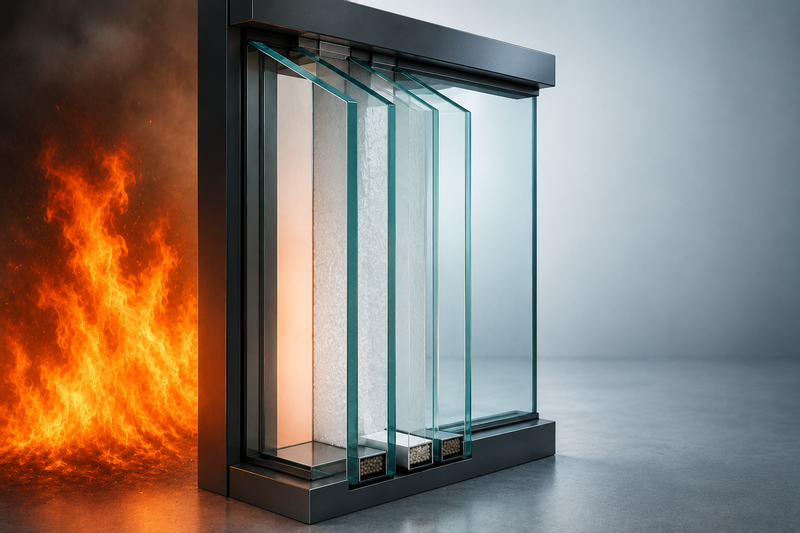
The protection does not arise from "thick glass," but from an intelligent material structure. The mechanism works as follows: A transparent hydrogel layer evaporates slowly, dissipates heat, and forms a heat-insulating layer. In detail:
The fire hits the glazing surface facing the fire compartment.
The hydrogel reacts with a delay, absorbs energy, and transforms into an opaque, insulating barrier.
The side facing away from the fire remains stable and cool enough to protect escape routes.
This process continues for the entire duration of the classification – typically 30 to 120 minutes.
Hydrogel-based fire-resistant glass with fire resistance classes EI 30 to EI 12
4. Legal Classification: Fire-Resistant Glass Is a State Matter
This is the core of the article – and a point that many competitors explain incorrectly or insufficiently. Building fire protection in Germany is not federal law. It is regulated by the 16 federal states. This means:
4.1 State Building Codes (LBO) Determine Use
Each federal state defines independently:
which components must be fire-retardant, highly fire-retardant, or fire-resistant
where transparent components are permitted
what fire resistance duration is required
The Model Building Code (MBO) is not binding. It serves only as a template.
4.2 The MVV TB Is Implemented Differently
The Model Administrative Regulation on Technical Building Regulations references standards and testing rules – but:
not every state adopts them completely
some states add state-specific additions
special building regulations (e.g., SchulbauVO, KrankenhausbauVO, assembly facilities) apply additionally
4.3 Standards Define the Technical Basis
The standards are uniform nationwide, but when and where is decided by each federal state:
DIN 4102-13 (national regulation, national classification F/G)
DIN EN 13501-2 (European classification E/EW/EI)